

“I knew nothing about cows or computers, and yet I was right in the middle of it.”
In October 1987, Monique Otten and her boyfriend bought a computer. Not just any computer, but a complete management system: the GM2000, which came with five years of business support. They bought it from Gascoigne Melotte for 18,000 guilders. Already owning a feeding computer, the ID2000, they linked it to the new system. What followed wasn’t just a simple farm installation—it was a whole journey that went far beyond software.
Getting the hang of something you’re not familiar with
Every six weeks, the computer literally hit the road. The bulky unit was unplugged, stowed in the back of the car, and taken to a hotel, where Fons Pigmans held the meetings. For Monique Otten, it was far from routine. She was a fashion designer, working long hours, and “agricultural terms were pure gibberish to me, and I didn’t know the first thing about computers.”
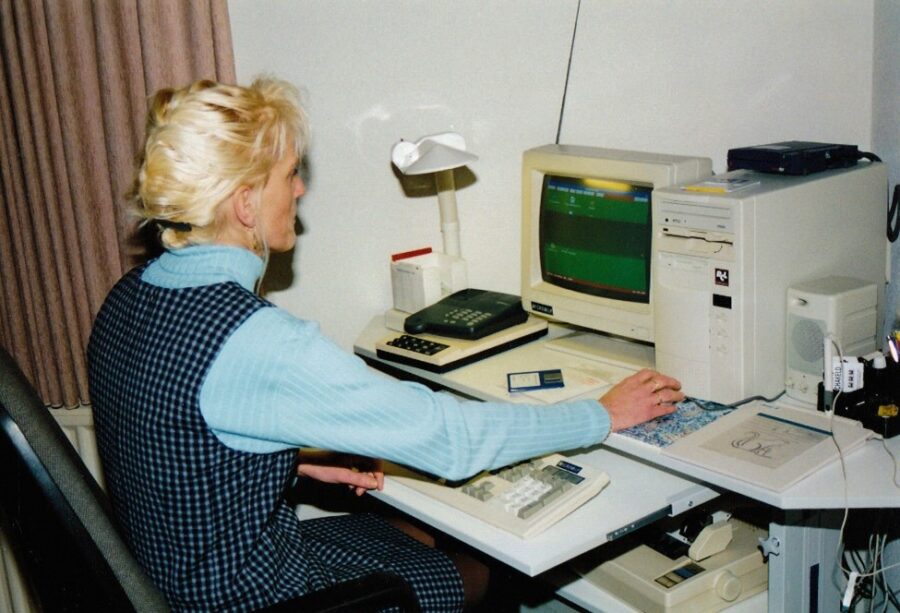
Monique Otten with their first computer, purchased in 1987.
Still, she went along. Friday afternoons were her only free time, and she decided to spend them getting familiar with the system, alongside her then-boyfriend, who has now been her husband for 36 years.
From confusion to curiosity
What began as something completely unfamiliar slowly became something she could take control of. “Fons said, ‘I’ll teach you. Not just the management program, but the computer itself.’” He explained everything patiently, sometimes more than once. “Until I really got it.” That approach made all the difference. She didn’t just learn to use the program, she also picked up the basics of the computer, MS-DOS included. “That way, I didn’t get stuck so easily and could keep moving forward.”Still, she went along. Friday afternoons were her only free time, and she decided to spend them getting familiar with the system, alongside her then-boyfriend, who has now been her husband for 36 years.
Software that grows with the farm
The program was more than just technology. It evolved alongside its users. Bert Blok, the developer (later with UNIFORM-Agri and eventually a self-employed entrepreneur), played a key role in this process. Whenever something didn’t work or could be improved, a call was made. And if Fons Pigmans couldn’t solve it, Bert usually had the answer. Practical needs were taken seriously. Issues from the farm made their way into the program, and when several farmers had the same requirement, the system was adapted accordingly.
“Basically, the current management program was born from all these adjustments.”
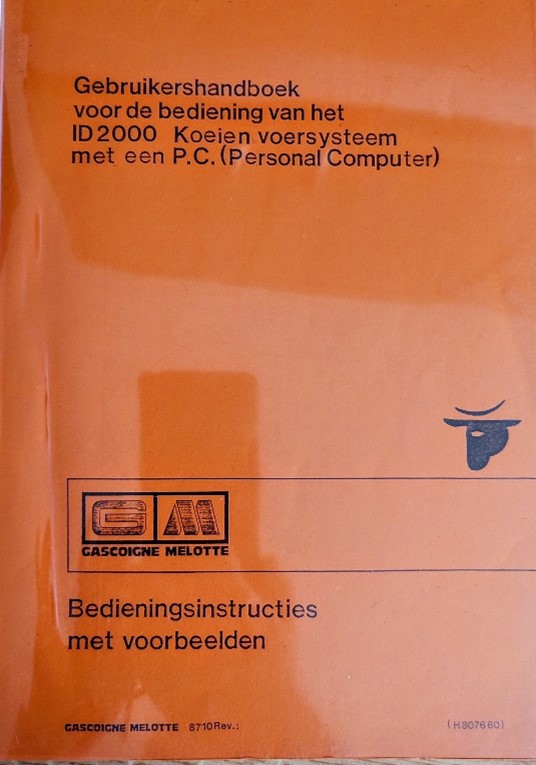
User manual for the management system purchased from Gascoigne Melotte, which later became VeKuSoft UNIFORM, the predecessor of UNIFORM-Agri.
Working within the limits of the time
The way of working was completely different back then. Many tasks took time and required patience. “If you wanted a feed calculation done, you had to start it before meals, and it would take about an hour. Before you could do anything, you often had to go through multiple steps in the program, which took a lot of time. I also entered the milk control data by hand for a long time.”
From slow and complex to fast and intuitive
Over the years, everything changed. “Now it’s all much more user-friendly, faster, and everything is read in via the internet, making it easier. With major changes, you always had to relearn how things worked. Sometimes you wonder how long you can stay flexible enough to keep up.”
Keeping up with the changes
But that’s exactly what’s needed. “You have to keep up with it, that’s a fact. We’ve always worked well with the program. Not everything was used optimally, but that’s true for any program. Everyone has their own preferences and focuses on what’s important to them.”
From the past to the present
Monique Otten’s story shows how software works in practice: not as a ready-made product, but as something you learn, adapt, and make your own.
What began with a computer that went in the car every six weeks has grown into a system that runs in the background, processing data automatically as it is entered and retrieved.
But one thing has remained the same: the user is at the center.
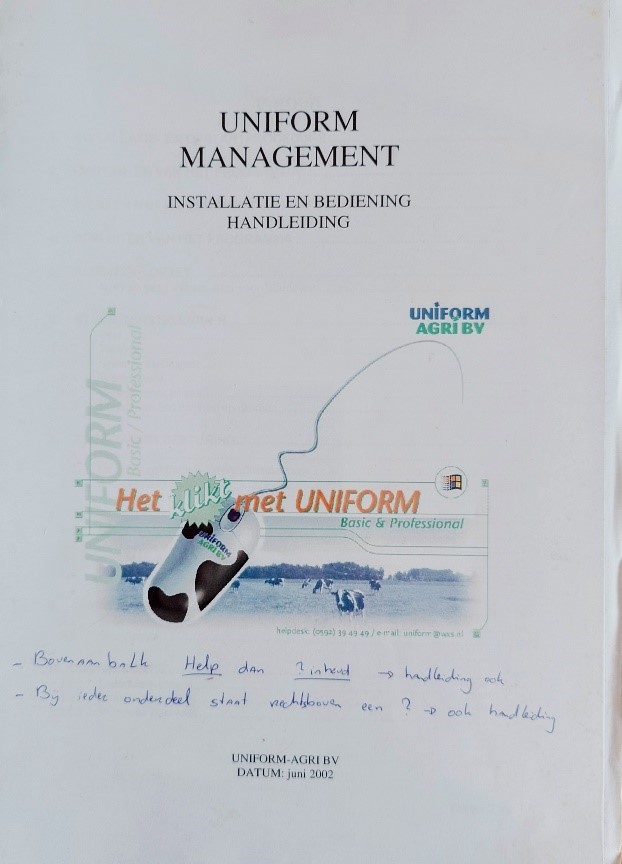
User manual UNIFORM Herd Management Program

