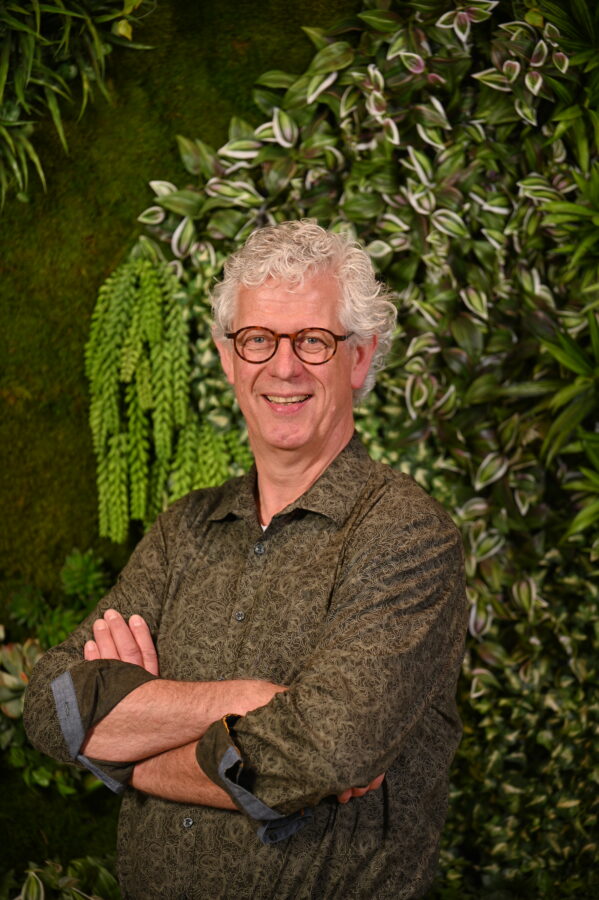

“You can do a lot on your own, but in the end, you achieve the most together”
40 years in 40 stories: Guido IJpelaar
Few people have witnessed UNIFORM’s growth and development as closely as Guido IJpelaar. Since March 1995, he has been helping dairy farmers make the transition to digital farm management. While he once spent much of his time on the road visiting customers, today a large part of that contact takes place online. When Guido joined UNIFORM, computerisation on dairy farms was still in its infancy. “Everything was new,” he says. “For the farmers and for us.” As a sales representative covering the southern Netherlands, he helped dairy farmers take their first steps towards using computers and software in their day-to-day farm management.
The first steps towards digital farming
“When I started, there were no CDs yet. Everything ran on floppy disks. Some farmers were even still using those big, flexible floppy disks.” One of Guido’s first jobs was visiting dairy farmers who had been introduced to UNIFORM a few months earlier at the RAI Amsterdam trade show. It was there that UNIFORM first demonstrated how farmers could submit animal registration records through its herd management software. Many farmers subsequently signed up for a trial version of the program.
At the time, this was a major breakthrough. Until then, farm management software had mainly been used for keeping records on the farm itself. For the first time, farmers could also exchange information digitally with government agencies and other organisations.
When Guido joined UNIFORM, he visited these farmers to help them get started and discuss whether they wanted to continue using the software after the trial period. For many of them, working with computers was a completely new experience. In those days, computers were far from common on farms. Sometimes the neighbours would even stop by to see one being installed. “It was a bit like when the first colour TVs arrived,” Guido says.
A sales representative with no computer experience
What makes the story even more remarkable is that Guido had never used a computer before joining UNIFORM. One day, his colleague Jan Venema turned up at his house with a complete PC, monitor, keyboard and mouse included. The instructions were straightforward: the Escape key in the top left corner would take him back a screen, and the Enter key in the bottom right corner would move him on to the next one. Everything else, he would pick up as he went along. Guido still laughs when he thinks back to those days. “That was about all I knew about computers at the time.”
Payphones and spare change
It is hard to imagine now, but when Guido started, there were no mobile phones and no internet. If he had a question for the support team while out visiting customers, he would drive to the nearest village. In those days, there was usually a payphone near the church, so he always kept a supply of coins in the car.
Getting from farm to farm meant relying on large road atlases and street maps. Later, he was given a car phone. If he got lost on his way to a farm in the evening, he would call the farmer and explain where he was. Sometimes the solution was surprisingly simple. The farmer would switch the yard light on and off a few times, allowing Guido to spot the farm in the distance and find his way there.
Growing with the company
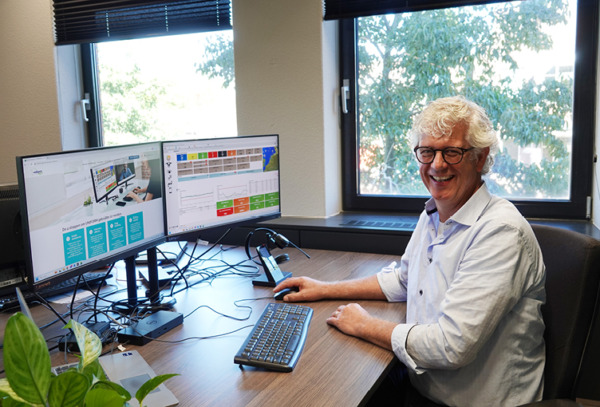
When Guido joined UNIFORM, there were just 13 employees. Today, the company has grown to more than 100 colleagues. Over the years, he has seen almost every major development firsthand, from the early days of DOS software and floppy disks to the arrival of the internet, mobile phones and online data exchange.
But what stands out just as much to him is how the organisation itself has evolved. “We moved offices several times. Some colleagues left, new ones joined, and the company continued to grow.” According to Guido, success is about much more than technology. “You’re part of a team. I can’t do my job without the support team, the development team, or my colleagues.”
Learning from a new generation
One of the milestones in Guido’s career was the arrival of a younger generation of colleagues. “At one point, people started joining the company who were closer in age to my children than to me.” It gave him a new perspective. With the help of a coach, he learned a lesson that has stayed with him ever since. “Don’t fight the younger generation. As soon as you start fighting them, you’ve already lost.”
Instead, he learned to build on each other’s strengths. “Younger colleagues are often quicker to embrace new technologies and digital tools. I bring experience. When you combine the two, you become stronger together.” That spirit of collaboration is still one of the things Guido values most about UNIFORM.
Why leave?
Over the years, Guido had several opportunities to work elsewhere. Even after spending many years at UNIFORM, he occasionally had conversations with other companies. But he always came to the same conclusion. “Why would I leave?” He enjoyed his work, had a good relationship with both customers and colleagues, and was given plenty of freedom in his role. “I found my place here.”
You achieve more together
After more than thirty years on the road, Guido has experienced both the rewards and the challenges of the job. “As a sales representative, you spend a lot of time alone in the car. Every success is yours alone, and every disappointment is something you have to deal with yourself.”
That is exactly why teamwork means so much to him. When he secured a good order, he would call a colleague. When he had a disappointing day, he would do exactly the same. For Guido, that may be the most important lesson he has learned during more than thirty years at UNIFORM: “You can do a lot on your own, but in the end, you achieve the most together.”