

40 years of software for the dairy farm
In conversation with Harm-Jan van der Beek
Genderen, the Netherlands. Harm-Jan van der Beek lives on the farm in Genderen where he grew up. Although he would have loved to become a dairy farmer, life took him in a different direction. His interest in science and numbers eventually led him into software, but he never lost his connection with farming. Today, management software helps farmers around the world manage their herds more efficiently.
He has fond memories of his childhood. “When I was a little boy and my hands were cold, I would go into the barn and put them between a cow’s udder and hind leg. The cows were incredibly gentle.” In summer, the cows grazed outside, while in winter each cow had its own place in the barn. “My father was already milking 45 cows, which was quite a lot at the time. If I close my eyes, I can still remember the names of all the cows,” Harm-Jan says with a smile. His father died in 1973, and his mother tried to keep the farm going. “I was thirteen at the time. She carried on for another two years or so. After that, it became an arable farm.”
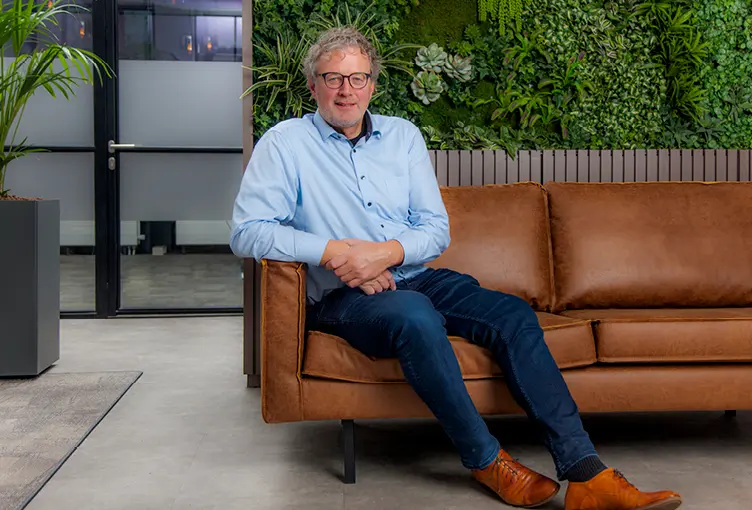
The farm was too small a world
He never lost his love of cows. “I really wanted to become a farmer, but my back wasn’t strong enough. I studied at Wageningen Agricultural University. Alongside one of my minor subjects, I worked three days a week on my uncle’s farm. But I had to conclude that physically, I wouldn’t be able to keep doing that in the long term. I also felt that life on the farm would be too small a world for me. Then I got in touch with someone who was developing software.” That meeting ultimately led to the creation of UNIFORM-Agri. “This year, the company celebrates its 40th anniversary,” he says proudly.
A fascination with numbers
His fascination with figures runs in the family. “My father already kept a very precise list of when each cow was in heat. I thought that was fascinating.” That same type of information plays a central role in UNIFORM-Agri software today. “Cows come into heat roughly every three weeks, which is when they can be inseminated. Around eight weeks before calving, you dry them off. You can record everything in our app, including fertility, how many days a cow spends outside, health information, which medication has been administered and even the batch number of that medication. Our software is used all over the world. Today, we manage data for around six million cows.”
Bilingual employees
“We have around 20,000 farmers as customers worldwide, most of them outside the Netherlands. Our employees represent thirteen different nationalities. Everyone in our call centre is bilingual, so farmers can always be helped in their own language. All information is recorded in the CRM system. That means if a farmer speaks to someone else the next day, that person knows exactly what has already been discussed.” Customer service performance is monitored closely. “Our target is for 90 percent of our customers to have someone on the line who can help them within 120 seconds.”That direct contact with farmers is also valuable for developing the software, Harm-Jan explains. “If you notice that a lot of questions are being asked about a particular subject, you know you need to do something about it.”
Using common sense
Harm-Jan sees clear similarities between the use of data today and how farmers compared themselves in the past. “In the old days, you would milk the cows out in the field. On the way back, everyone could see how many milk churns were on the cart.” Even then, farmers kept an eye on how their neighbours were doing. How is he performing compared with me? “That is similar to benchmarking in today’s software, where you compare your data with someone else’s. But if a farmer simply filled his milk churns less, it looked as though he had produced a huge amount of milk. So standardisation is important. It is the only way to make a proper comparison.” Software helps with that, although you still need to use your common sense as a farmer. Comparisons between countries, for example, do not always tell the whole story. “In Ethiopia, there are huge numbers of cows, but many of them are not primarily kept for dairy production. The cow produces manure, which is important for the banana tree, and the banana tree generates the income. Milk is a by-product there. In Vietnam, we are involved in a large project where we manage 60,000 cows, but there are also thousands of small-scale farmers with just three or five cows. They can record everything using an app on their phone.”
Respect for farmers
Closer to home, Harm-Jan sees just how much Dutch livestock farmers do for their cows. “The farmer often takes better care of his cows than he does of his wife! They get a pedicure, a dietitian comes to see them, they sleep on waterbeds, they have massage brushes and they even get regular check-ups,” he jokes. “A cow can only produce a lot of milk if she is well looked after.” He has enormous respect for the agricultural sector. “Everything you eat or drink is produced by farmers: bread, beer, chips, cheese, butter and yoghurt. Some of them work 90 hours a week. Farmers deserve a little more respect.” He is concerned about government policy imposed from The Hague. “At UNIFORM-Agri, we are in a good position to compare the Netherlands with other countries. The Netherlands has the most efficient and sustainable dairy herd. There is less youngstock, and animals live longer than they do in other countries. Yet farmers are still being forced to stop farming. A lot is going wrong there.” He believes the compensation arrangements also fall short. “You receive additional compensation for your buildings based on their book value, but not for your cows or your land. If farmers are being asked to stop, then create a fair scheme that also allows older farmers, whose buildings have almost been fully depreciated, to do so. Too many decisions are being made by people who don’t understand farming. That really concerns me.”
Local politics
Speaking of politics, Harm-Jan has been politically active since his twenties. That interest also runs in the family. His grandfather and father were involved in politics, while his mother was one of the first female municipal councillors in Aalburg. After two and a half terms as chairman of CDA Altena, he will soon be handing over the reins. Has that role given him an opportunity to stand up for farming? “There is only so much you can do in local politics because you are bound by provincial, national and European regulations.” He gives the irrigation ban in the province of North Brabant as an example. “Altena is part of the province, but it also falls under the Rivierenland Water Authority. Conditions on sandy soils were completely different from those here, between the rivers. Decisions like that should therefore be made at municipal level.” He would also like to see farmers working together more and consumers making a greater effort to buy directly from farms. “Take a dairy farm with its own farm shop, for example. It can easily sell products from other farmers as well. Consumers should buy more directly from farmers and pay a fair price. Farmers have to put in a tremendous amount of work. They need land and machinery to work that land. But who do you see in the Quote 500 list of the wealthiest people in the Netherlands? The owners of supermarket chains, not farmers.”
Looking ahead
His work remains important to him, even after 40 years. “Cows are my passion, and I can combine that very well with the commercial side of the business. I also love travelling. I travel all over the world.” His own role within the company has changed over the years. “I used to own the company, but I sold it 13 years ago. Until last year, I was still the managing director. I’m 65 now and I want to make sure everything is properly arranged with the shareholders, while also ensuring that the company culture is preserved.” He sees the same passion for dairy farming among his colleagues and greatly values the loyalty of UNIFORM-Agri customers. “One of our very first customers bought our software back in 1984 and has kept records in it ever since. A calf was born there recently, and we were able to trace its pedigree back fifteen generations. Dedicated breeders really appreciate that.” The company is currently working on expanding into the beef sector. “That is particularly interesting for South America. There is demand there for software to manage semen sales and, for example, record the weight of beef cattle so farmers can monitor whether they are growing well enough.” So, for the time being, there is still plenty of work to be done.
This interview was previously published in #trotsopdeboer, a magazine by Kontakt Mediapartners, June 2026.

